CRM Re-engagement Playbook
Revive pipeline you already paid for. Claude Code finds why each deal really died from its call recordings, and a deal only comes back once something has changed that answers that objection.
See this playbook on your market
We'll find companies in your market where something changed this quarter, like a new leader, a raise or new hiring, the kind of change that brings a lost deal back, and email you the list.
Just want the playbook?
Tools used
 HubSpot
 Gong
 Claude Code
 Sumble
 RB2B
 PredictLeads
 IcyPeas
 Prospeo
 LeadMagic
 GetLeads
 MillionVerifier
 BounceBan
 Jev
 OpenRouter
 Slack
 Salesfinity
 LinkedIn
 Gmail
 EmailBison
How it works
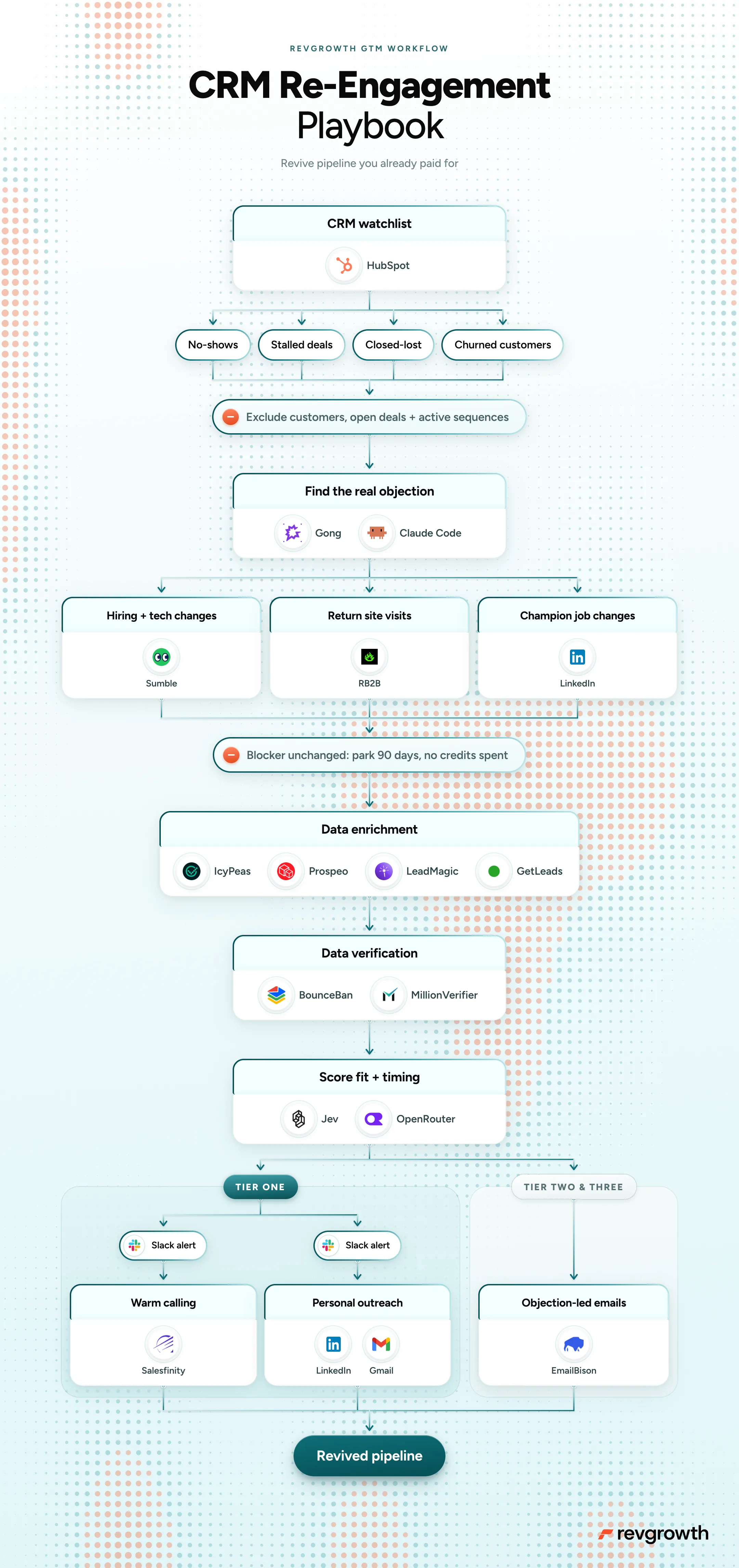
No-shows, stalled deals, closed-lost deals and churned customers from the last twelve months go on one watchlist.
- Put four groups from HubSpot on the watchlist:
- No-shows: booked a meeting and never showed
- Stalled deals: open, with no movement
- Closed-lost: deals you lost
- Churned customers: accounts that stopped paying, picked up six to nine months after they left
- Keep each contact's history with them: campaigns, replies, calls and the last touch.
- HubSpot
- Put four groups from HubSpot on the watchlist:
Anyone who is already covered, or asked not to hear from you, comes off the watchlist.
- Current customers and open deals stay with their owners.
- Contacts already in an active sequence are left out until it ends.
- Anyone who opted out never comes back.
The lost reason in a CRM dropdown is often a guess. Claude Code reads the calls and writes down what actually stopped the deal.
- Claude Code reads each deal's Gong recordings and the notes on its HubSpot record.
- It names the blocker in one line, with the quote that shows it:
- Budget: no money for it this year
- Timing: another project came first
- Product: a feature they needed was missing
- Buyer: the champion had no authority, or left
- Incumbent: under contract with someone else
- It also writes down what would have to change for the answer to be yes.
- No-shows never had a call, so their blocker is logged as timing.
- For a churned customer, the blocker is why they left, from the last calls and notes before they cancelled.
- When the dropdown and the recording disagree, the recording wins.
- Gong
- Claude Code
- HubSpot
Every parked deal is checked against what has changed at the account since it died.
- Sumble: hiring, team growth and tech-stack changes, like the team that was too small now hiring, or the incumbent's tool leaving the stack.
- RB2B: a return visit to your site, above all to the pricing page.
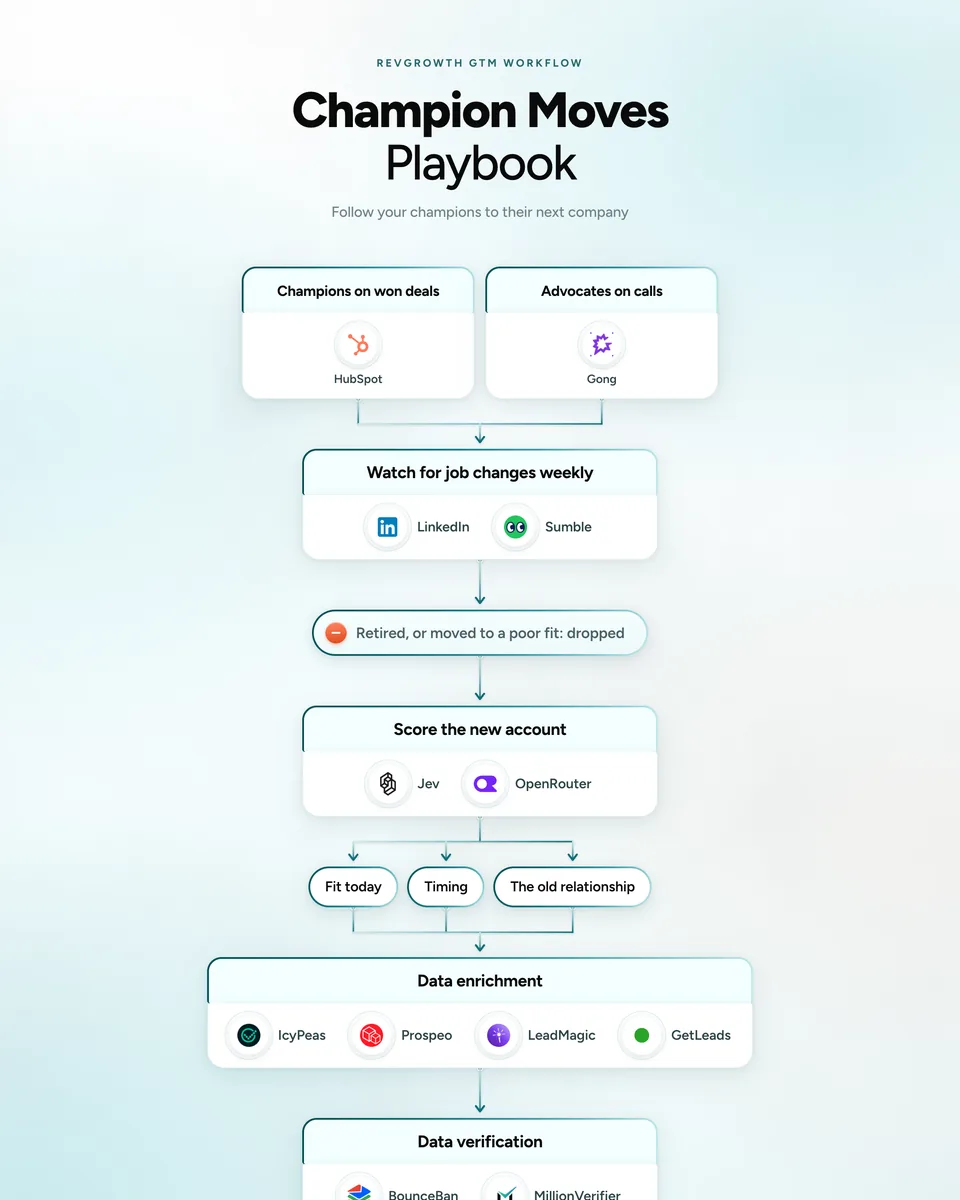
- LinkedIn: a champion changed jobs, caught by job-change alerts.
- New company: someone who already evaluated you is now buying somewhere else.
- Old account: a new person now owns the problem.
- PredictLeads: a new executive or senior hire at the account, reported in the news.
- Funding and your own releases count too. The feature they were missing may have shipped.
- Each change is logged on the account's HubSpot record with its type and time.
- Sumble
- RB2B
- LinkedIn
- PredictLeads
- HubSpot
A change only counts if it answers the objection. If nothing has, the deal is parked and checked again in 90 days.
- Each blocker is matched to the changes that answer it:
- Budget: new funding, or a new fiscal year
- Timing: the project that came first has shipped
- Product: the missing feature is live
- Buyer: a new leader owns the problem, or the champion resurfaced somewhere new
- Incumbent: the renewal date they gave you is coming up
- Churned: the reason they left is fixed, or the tool they moved to is up for renewal
- Moved: the account goes on to enrichment, verification and scoring.
- Unchanged: parked for 90 days, then checked again. No enrichment or verification credits are spent on it.
- Claude Code writes its reason on the record, so a rep can overrule the call.
- Claude Code
- Each blocker is matched to the changes that answer it:
People move on after a deal dies, so the contacts at each account are found again.
- Contacts change after a deal dies, so nobody is emailed from old data.
- Map the buying committee at each account:
- The decision maker
- A likely champion
- A day-to-day user
- The enrichment waterfall uses IcyPeas, Prospeo, LeadMagic and GetLeads.
- Each vendor only sees the contacts the ones before it missed.
- IcyPeas
- Prospeo
- LeadMagic
- GetLeads
Every email is checked twice before anything sends.
- Old addresses go bad over time, so every one is checked again, even if it passed before.
- MillionVerifier checks every address first, then BounceBan checks every address that passes.
- Sort each address by the result:
- Valid: kept for the campaign
- Catch-all: kept only if BounceBan marks it deliverable, and sent from its own campaign so its results read separately
- Invalid, disposable or unknown: removed
- An enrichment vendor's own check never counts as one of the two.
- A contact that fails keeps its place on the list with a flag, so no qualified person is silently lost.
- MillionVerifier
- BounceBan
Each account is scored against today's ICP, with the change that moved the blocker as part of the score.
- Jev and OpenRouter score fit against your ICP as it stands today, and timing from the change that moved the blocker.
- They classify and score only. Neither one enriches.
- The tier comes from fixed rules on top of their answers:
- Tier one: a strong fit, and a change that fully answers the objection
- Tiers two and three: a partial fit, or a change that only partly answers it
- No fit: left out
- Jev
- OpenRouter
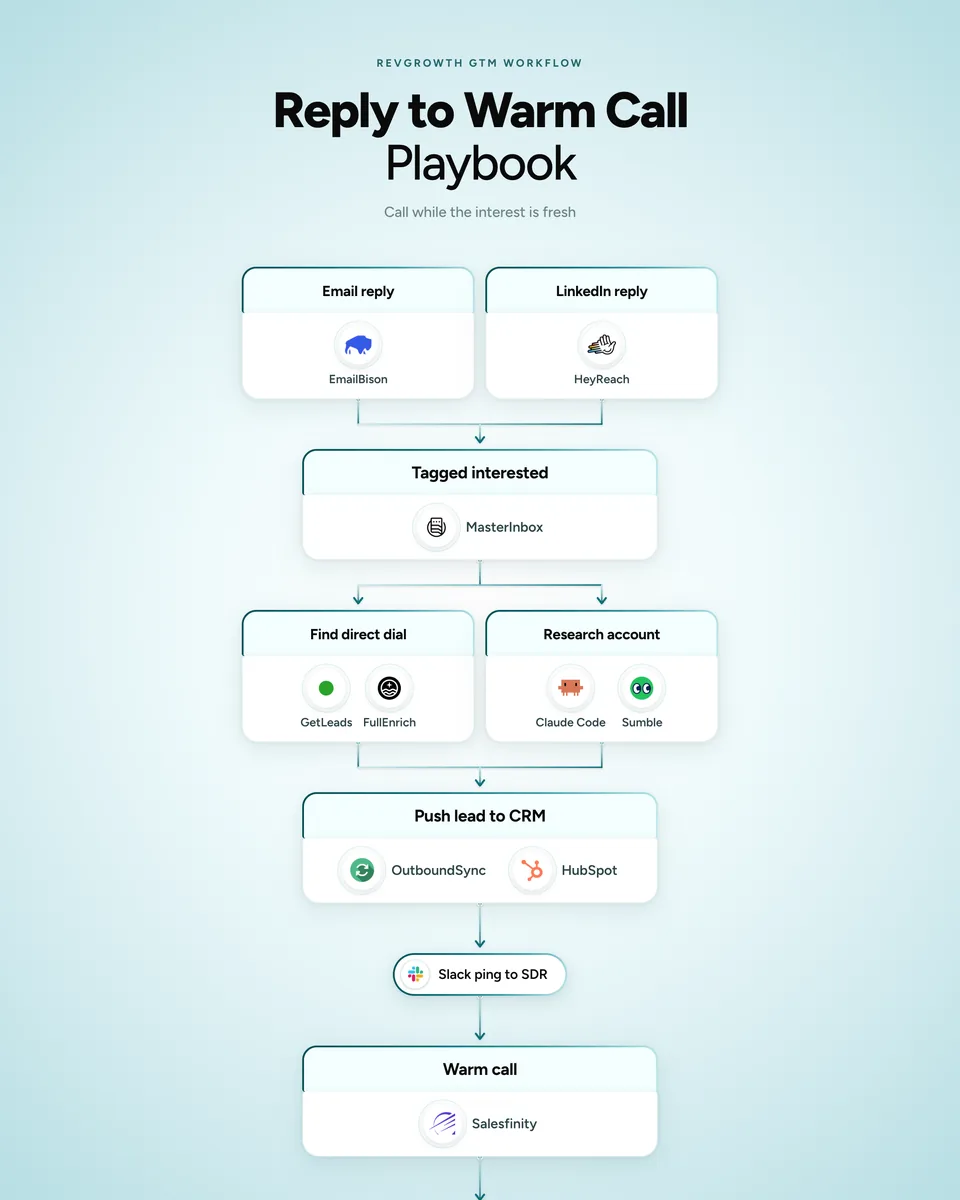
A Slack alert names the objection and what changed, then the owner works the account one to one.
- A Slack alert goes to the account owner with the objection, the quote from the call, and the change that answers it.
- The owner then works it one to one:
- A warm call on Salesfinity
- A personal note on LinkedIn or Gmail that picks up from the last conversation
- A short personal video
- Whatever the rep does from the alert is written back to the CRM.
- Slack
- Salesfinity
- LinkedIn
- Gmail
Automated emails open on the objection they gave you and what has changed since.
- Emails in EmailBison open on their own objection:
- "When we spoke in [month], [the blocker] was the problem. Since then, [what changed]. Worth another look?"
- The change has to answer the blocker. A budget objection gets the funding news, not a feature list.
- Say it the way a person would remember the call, never as a quote from the recording.
- An account that engages moves up to tier one.
- Frequency caps limit how often any one person hears from you.
- Sent from separate inboxes, so re-engagement never touches your new cold outreach.
- EmailBison
- Emails in EmailBison open on their own objection:
Want this running for your market?
We build it on your data and your offer, then run it with your team. It starts with a 30-minute strategy call.
Book a strategy call