For B2B companies with product-market fit
Cold calling across your whole market.
Real buyer research sets the ICP, full TAM coverage sets the list, and a parallel dialer works five lists into booked meetings. Every meeting is booked on the call and sent to you with the recording.
- The ICP built from call recordings, interviews, research and your deal history
- A direct number for the right decision maker before any contact reaches a caller
- A trained caller and a locked script: nobody dials your list on day one
- Every call and every booked meeting lands in your CRM
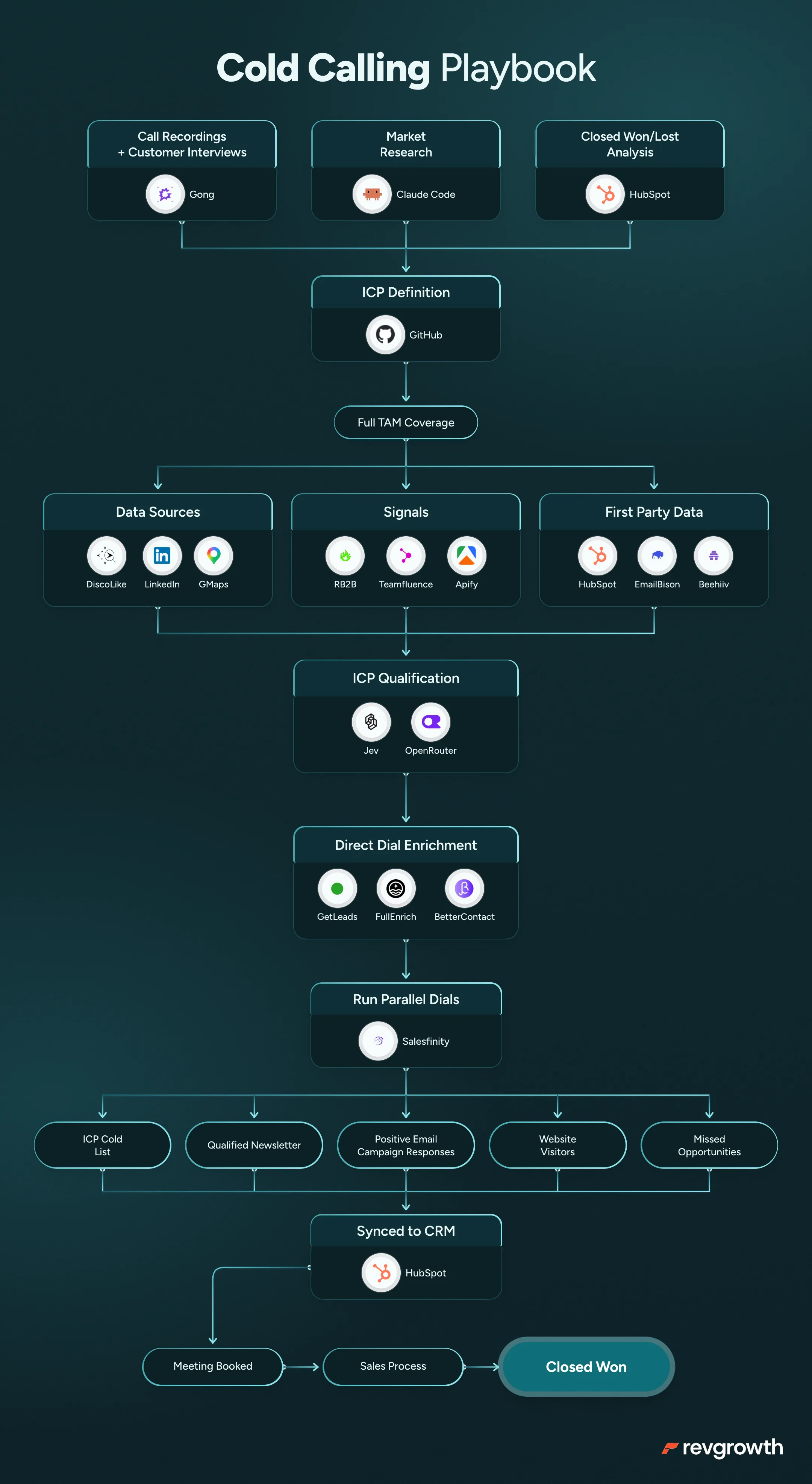
Map it, build it, run it.
The system we build and run for you, in three stages.
Map
- Your ICP, from call recordings, interviews and deals
- Full TAM coverage from data sources and live signals
- Your first-party data added in
Build
- A direct number for the right decision maker
- The caller trained on your market
- The script locked before day one
- Five lists ready, from cold accounts to missed deals
Run

- One dialer works five lists at once
- The meeting booked on the call
- Every call and booked lead in your CRM
- Booked meetings sent with the recording
Four steps are yours. We run the rest.
What the work looks like on your side, and everything we take off your plate.
You
- Share your calls and dealsCall recordings, customer interviews and your won and lost deals, so the ICP comes from real buyers.
- Approve the ICPOne written definition of who to target, agreed with you before anything sends.
- Approve the scriptYou sign off on the script before the first dial.
- Take the meetingsEvery meeting is booked on the call and sent to you with the recording. Your team takes it from there.
Revgrowth
- Build the ICP from real conversations
- Cover the full TAM
- Enrich for direct dials
- Train the caller and lock the script
- Run parallel dials across five lists
- Book the meeting on the call
- Sync to the CRM and close
What happens after you sign.
About three weeks from kickoff to the first dials, then the same rhythm every week.
From kickoff to the first dials
- Yours
- Ours
- Together
- Form and kickoff callA 15-minute form, a 30-minute call and a written recap the same dayTogether, Week 1
- Send your calls, lists and accessCall recordings, won and lost deals, the accounts to leave out, CRM access and a calendar open across US time zonesYours, Week 1
- Your ICP and segments, writtenFrom your call recordings, your deals and your marketOurs, Week 2
- Every company that fits, mappedFrom several sources, with live signals marking who to call firstOurs, Week 2
- Approve the ICPIn writing, within three business daysYours, Week 2
- Direct dials foundThe decision maker at each account, with a direct number from a three-vendor waterfallOurs, Weeks 2 to 3
- Script written, three variantsEvery line there for a reason, tested before it shipsOurs, Week 2
- Approve the scriptAll three variants, before the first dialYours, Week 3
- Caller trained and clearedHandbook, live training, recorded calls and your script from memory, signed off item by itemOurs, Week 3
- Approve the listAccount by account, before it loads in the dialerYours, Week 3
- First dialsFive lists at once, two to three follow-up calls on every lead, meetings booked on the callOurs, Week 4
The first dial date holds when your approvals come back within three business days. Each day of delay moves it by a day.
After launch
- Every dayFive lists dialed at once, from your cold list to missed deals, with two to three follow-up calls on every lead.
- Every booked meetingBooked live on the call in the lead's time zone, with the email spelled back, then sent to you with the recording and notes.
- Every callRecorded and logged in your CRM with its notes, in a live tracker your team can open any time.
- Every script testThree variants tested live, then the winner scaled. Callers never ad-lib your positioning.
- Every FridayA short written update in your Slack: dials, connects, meetings booked, what the calls said and what's next.
- Every list changeMade on what the calls showed. The ICP holds still long enough for the results to mean something.
Everything else you'd ask
How soon do the first dials start?
About three weeks after kickoff. The list sets the pace: your ICP, the accounts that fit and a direct number for the decision maker at each, approved by you before it loads. The caller trains on your market and your script in the same weeks.
Who makes the calls?
A trained caller dedicated to your market. Before your account goes live, every caller signs off item by item on our handbook, live training with our sales lead, recorded calls, tonality, objection handling and your approved script, from memory.
Do we approve the script and the list?
Yes. You approve three script variants before the first dial, and the list before it loads in the dialer. Callers never ad-lib your positioning.
How do meetings get booked?
On the call. The caller explains the offer, spells the email back and books the lead's preferred time on your calendar, which stays open across Eastern, Central and Pacific. A warm email follows that references the call.
What comes with each booked meeting?
The call recording, an email confirmed out loud, the time zone, notes, a follow-up log, a booking screenshot and who we actually spoke to, all in a tracker your team can open any time.
How many dials a day?
500 to 2,000, depending on your plan, across five lists at once, with two to three follow-up calls on every lead.
Can you add cold email?
Yes. Both channels share one ICP and one list, so someone who never picks up still gets two emails, and every reply lands in the same tracker as the calls.
Do you charge per meeting?
No. One flat monthly retainer, never a fee per meeting, and you can hear every call we make.
Book a strategy call.
Thirty minutes with Adam. We map your market with you and walk through the first campaign we would run.
What it produces.
Programs we run, in each client's own numbers.

The other services.
Every program runs on one map of your market, so the channels work together.
Cold email
Campaigns across your whole market, from the list to the reply.
See how it runsLinkedIn outreach
Connection requests and messages from your team's profiles, every reply routed to a rep.
See how it runsSignals and data
Every company that fits your ICP, who is in market now, and the decision maker at each, verified twice.
See how it runs