Competitor Reviews Playbook
Reach their unhappy customers first. Claude Code turns a competitor's reviews into complaint themes, Sumble finds the companies running their tool, and each account hears about the complaint you solve, refreshed every week as new reviews land.
See this playbook on your market
We'll turn your top competitor's reviews into the complaints you solve, find companies running its tool, and email you both.
Just want the playbook?
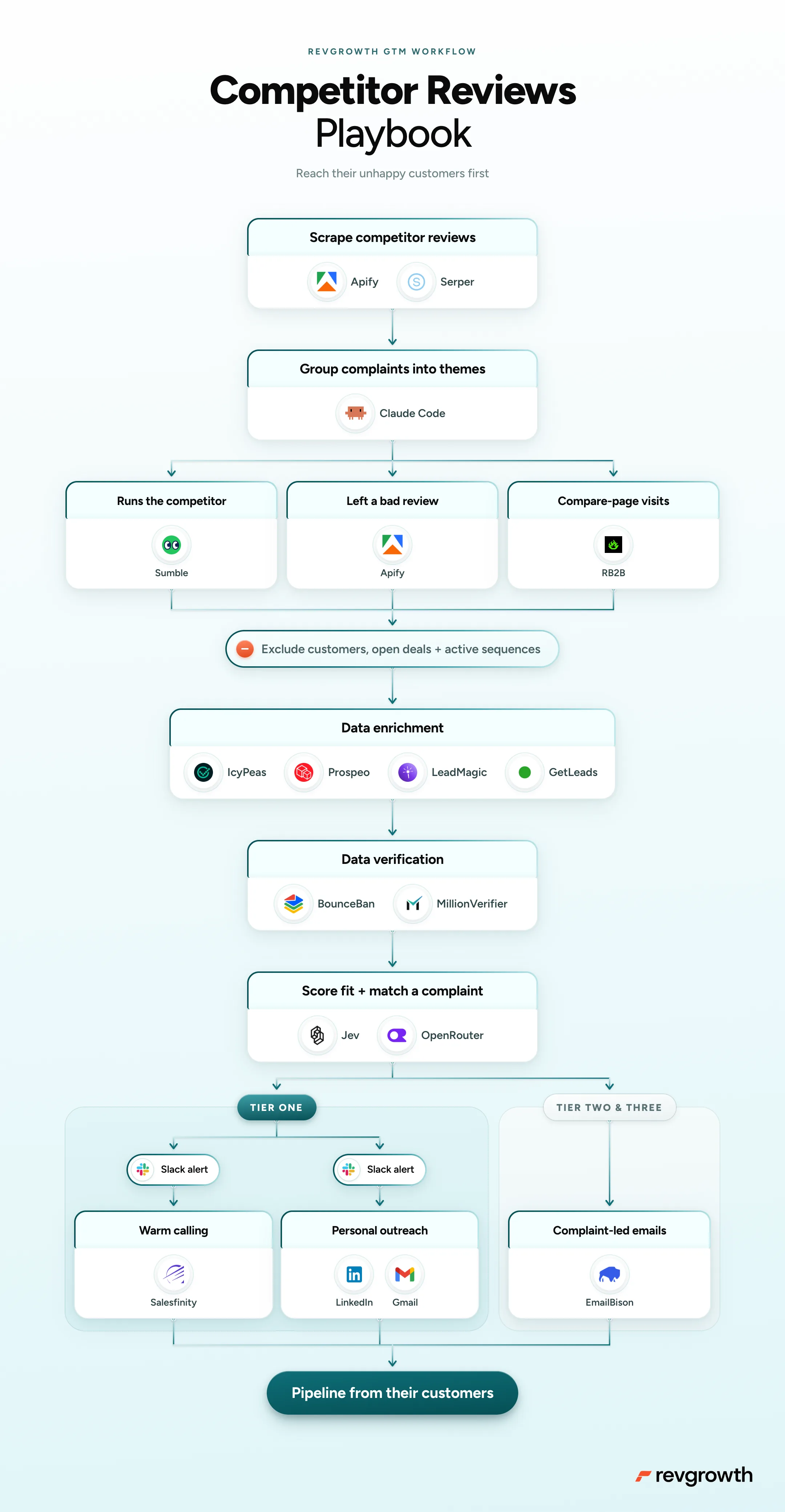
Tools used
 Apify
 Serper
 Claude Code
 Sumble
 RB2B
 HubSpot
 IcyPeas
 Prospeo
 LeadMagic
 GetLeads
 MillionVerifier
 BounceBan
 Jev
 OpenRouter
 Slack
 Salesfinity
 LinkedIn
 Gmail
 EmailBison
How it works
Two or three competitors with plenty of reviews, pulled from every site where their customers talk.
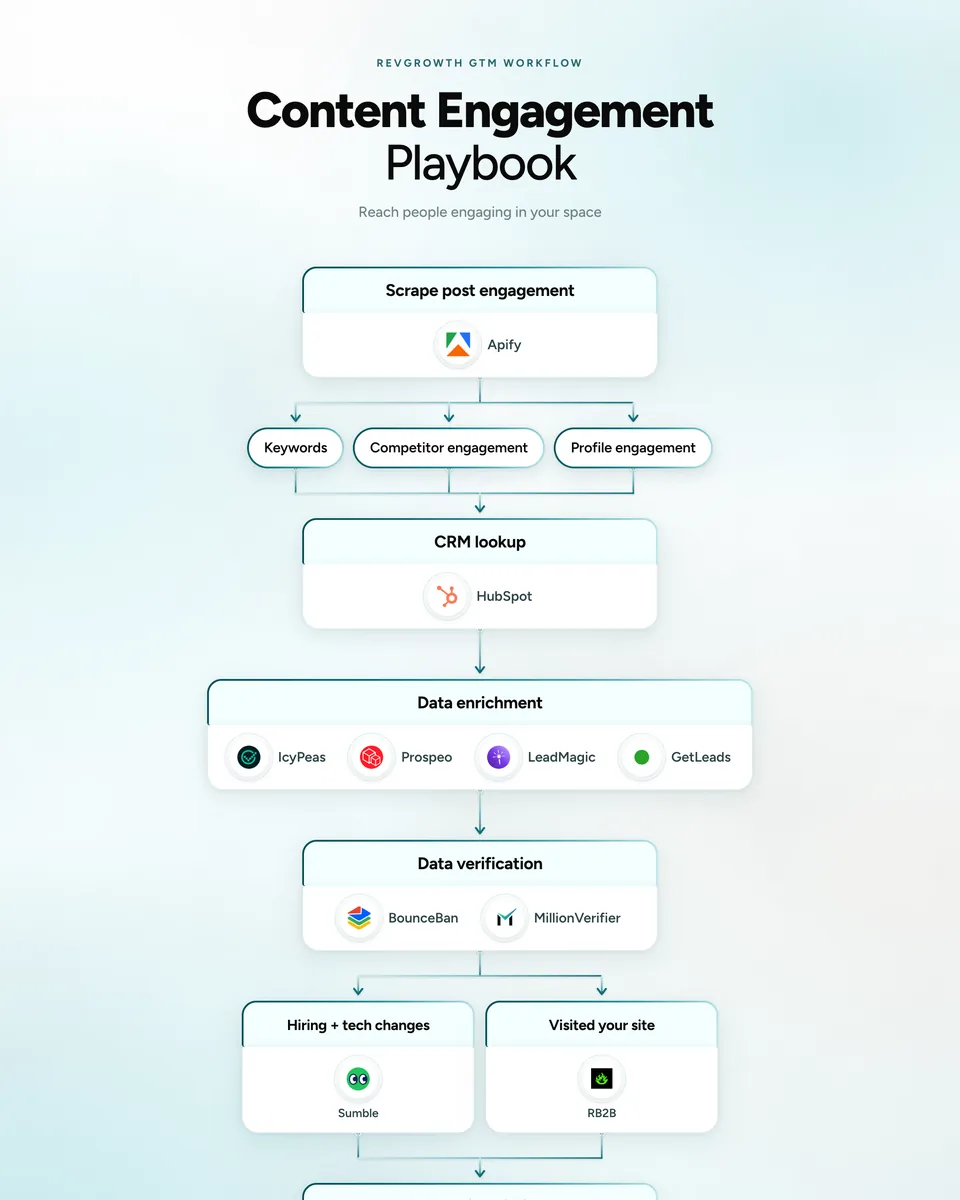
- Apify pulls reviews from G2, Capterra and Trustpilot, with each rating, date, role and company size.
- Serper finds the Reddit and forum threads where their customers complain in the open.
- Low ratings carry the complaints. High ratings show what you have to match.
- New reviews are pulled every week.
- Apify
- Serper
Claude Code reads every review and groups the complaints into the few themes that keep coming back.
- Claude Code tags each complaint and counts the themes, such as:
- Support that takes days
- An integration they needed and never got
- Price rises at renewal
- A setup that never finished
- Each theme keeps its real quotes and who wrote them: role, company size and industry.
- Only themes you actually solve are kept. A complaint your own customers share is a trap.
- Each theme gets its answer: the proof you handle it, such as a support SLA, the integration, or public pricing.
- Claude Code
- Claude Code tags each complaint and counts the themes, such as:
Three ways to find accounts on the competitor's tool, and the ones already unhappy with it.
- Sumble: the company's job posts name the competitor's tool, which shows who runs it and how much they lean on it.
- Apify: reviewers who left a low rating and named their company.
- RB2B: a visit to your comparison or alternatives page, a sign they are already shopping.
- A Sumble match only counts when it lands on the account's exact domain.
- Sumble
- Apify
- RB2B
Anyone already covered comes off the list, your own customers first.
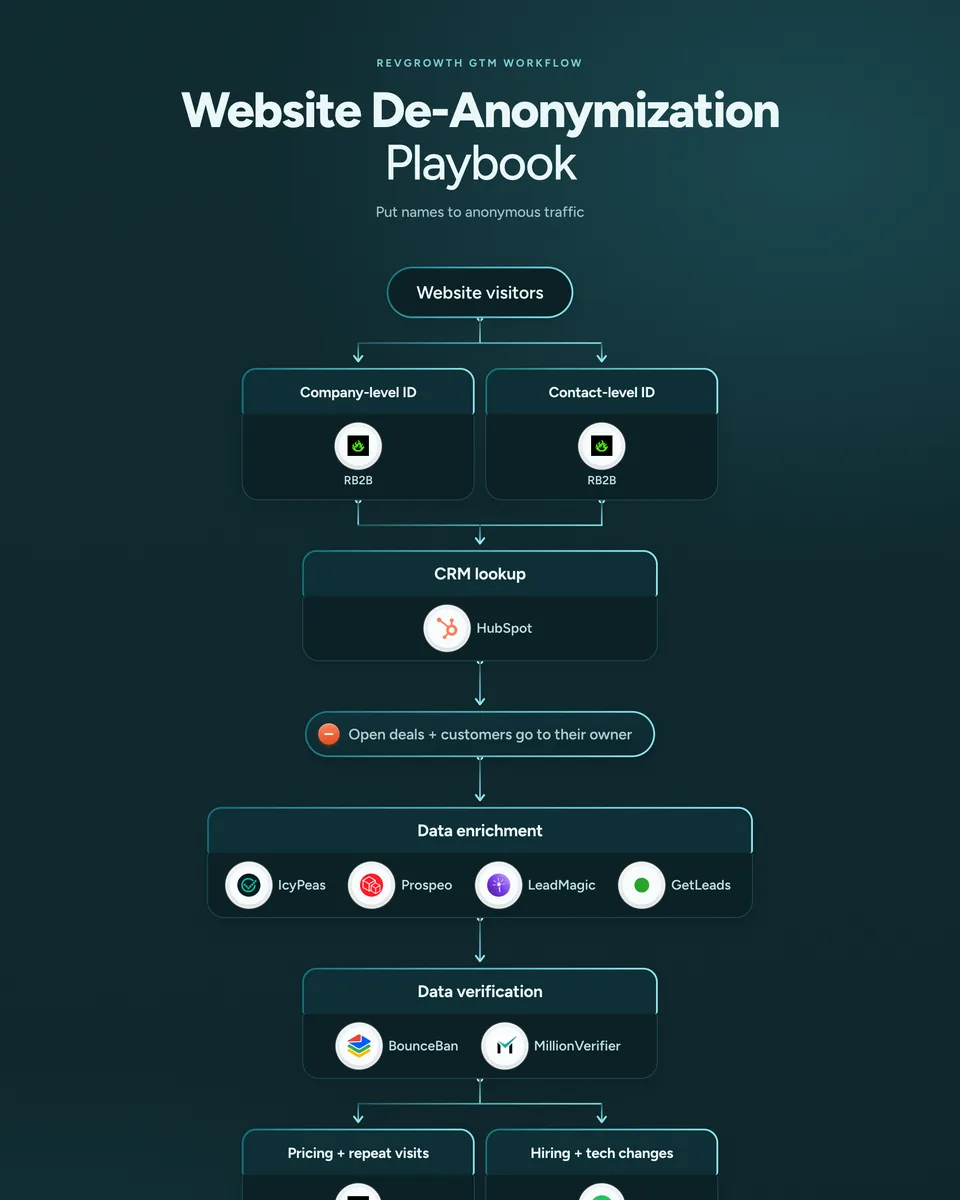
- Check every account in HubSpot before anything else happens.
- Your own customers sometimes run the competitor too. They go to their account owner, never into this campaign.
- Open deals stay with their rep, and active sequences are left to finish. Anyone who opted out never comes back.
- HubSpot
Each account gets a decision maker, a champion and a user, each with a work email.
- Map the buying committee at each account:
- The decision maker
- A likely champion
- A day-to-day user of the competitor's tool
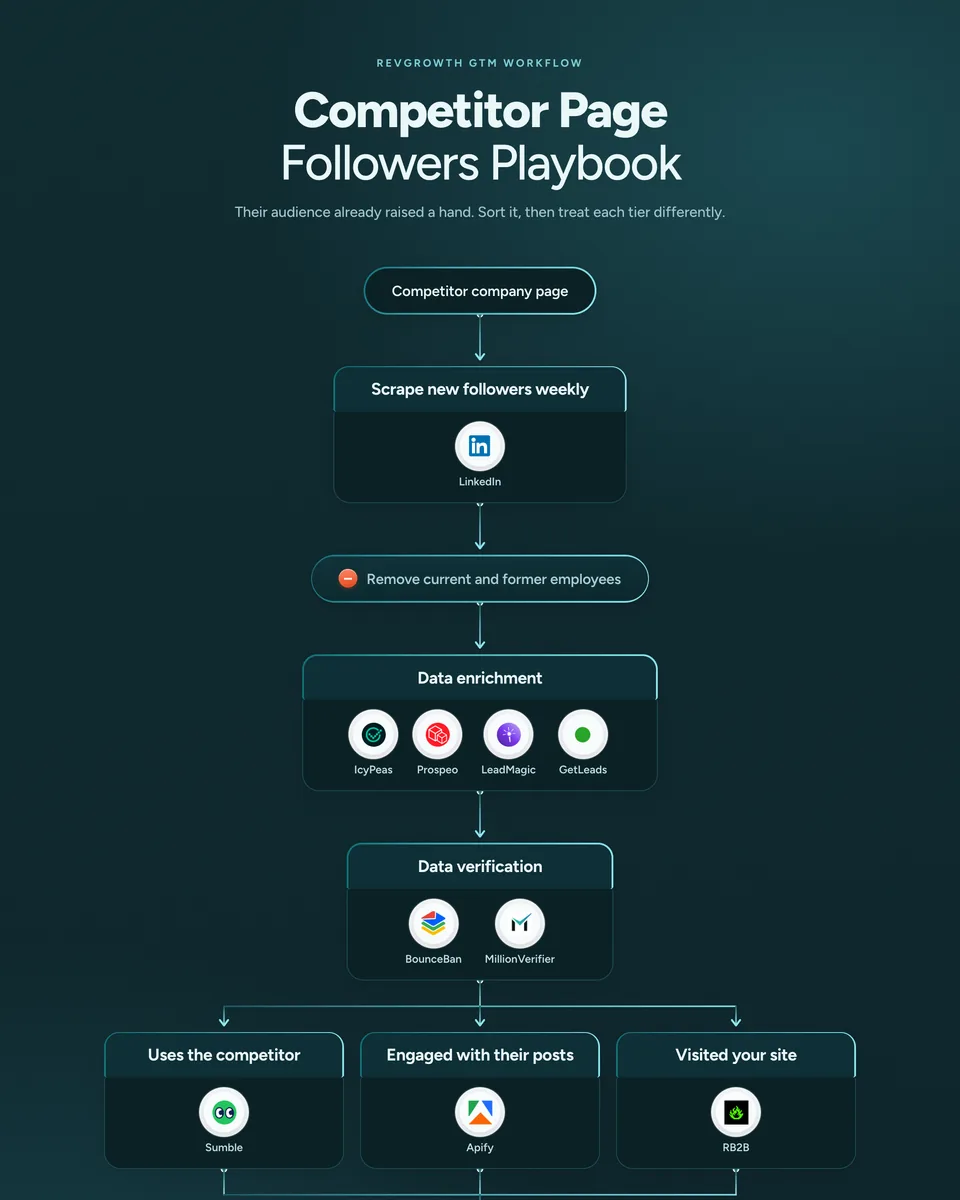
- The enrichment waterfall uses IcyPeas, Prospeo, LeadMagic and GetLeads.
- Each vendor only sees the contacts the ones before it missed.
- IcyPeas
- Prospeo
- LeadMagic
- GetLeads
- Map the buying committee at each account:
Every email is checked twice before anything sends.
- MillionVerifier checks every address first, then BounceBan checks every address that passes.
- Sort each address by the result:
- Valid: kept for the campaign
- Catch-all: kept only if BounceBan marks it deliverable, and sent from its own campaign so its results read separately
- Invalid, disposable or unknown: removed
- An enrichment vendor's own check never counts as one of the two.
- MillionVerifier
- BounceBan
Each account is scored on fit, then matched to the complaint theme that fits it best.
- Jev and OpenRouter score fit against your ICP, and pick each account's theme from its size, industry and signals.
- The reviewers are the evidence. A theme raised again and again by 50-person agencies fits a 50-person agency.
- They classify and score only. Neither one enriches.
- The tier comes from fixed rules on top of their answers:
- Tier one: a strong fit that left a bad review or visited your comparison page
- Tiers two and three: a fit that runs the competitor, with no sign of pain yet
- No fit: left out
- Jev
- OpenRouter
A Slack alert with the complaint and your answer to it, then one-to-one work.
- A Slack alert gives the owner the account, the signal, the matched complaint and your answer to it.
- The owner then works it one to one:
- A warm call on Salesfinity
- A personal note on LinkedIn or Gmail
- Never quote their own review back to them. Name the problem the way anyone in their seat would.
- Whatever the rep does from the alert is written back to the CRM.
- Slack
- Salesfinity
- LinkedIn
- Gmail
Emails open on the complaint their peers keep raising, then show how you handle it.
- Emails in EmailBison open on the theme matched to them:
- "[Competitor] reviews keep coming back to [complaint]. We [how you handle it]. Is that a problem at [company] too?"
- The competitor is named only when the account is known to run it.
- Every claim about your product has to hold up. They will check it against their own experience.
- Two emails in total, no link in the first, and open tracking off.
- New reviews every week bring new themes and new angles, so the emails are refreshed as they land.
- EmailBison
- Emails in EmailBison open on the theme matched to them:
Want this running for your market?
We build it on your data and your offer, then run it with your team. It starts with a 30-minute strategy call.
Book a strategy call