Modern Outbound Playbook
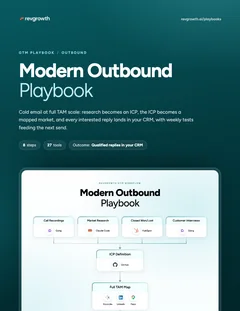
Cold email at full TAM scale: research becomes an ICP, the ICP becomes a mapped market, and every interested reply lands in your CRM, with weekly tests feeding the next send.
See this playbook on your market
We'll map your market and email you companies that fit what you sell, each with the line from its own website that shows why.
Just want the playbook?
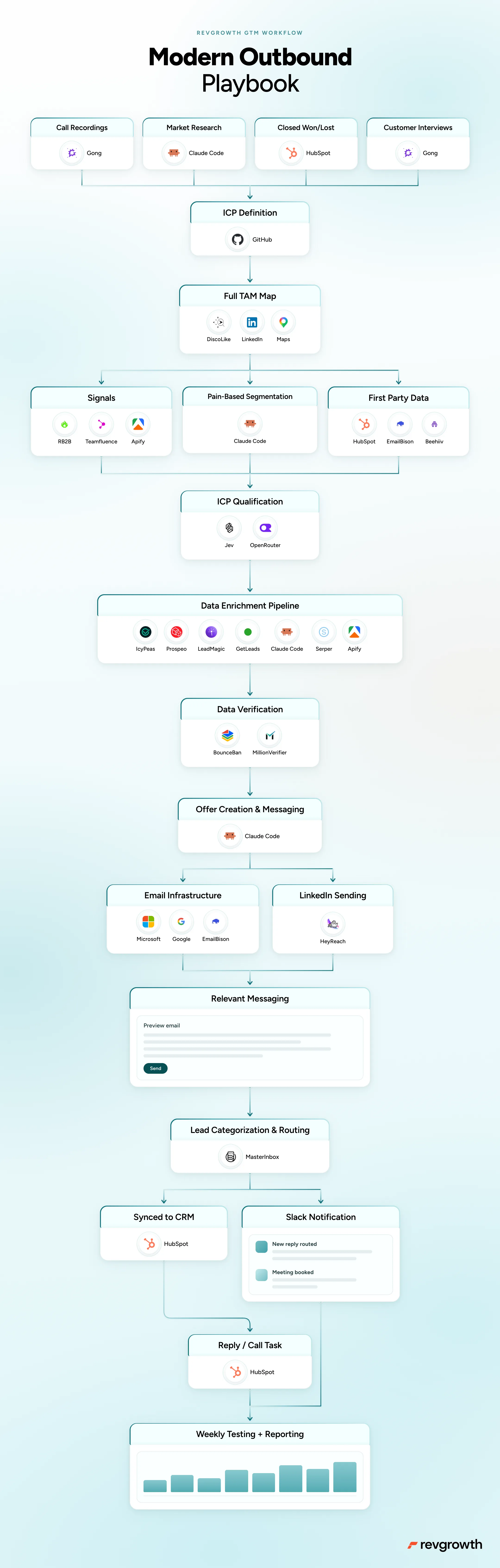
Tools used
 Gong
 Claude Code
 HubSpot
 GitHub
 DiscoLike
 LinkedIn
 Google Maps
 RB2B
 Apify
 Teamfluence
 EmailBison
 Beehiiv
 Jev
 OpenRouter
 IcyPeas
 Prospeo
 LeadMagic
 GetLeads
 Serper
 MillionVerifier
 BounceBan
 Google
 Microsoft
 HeyReach
 MasterInbox
 OutboundSync
 Slack
How it works
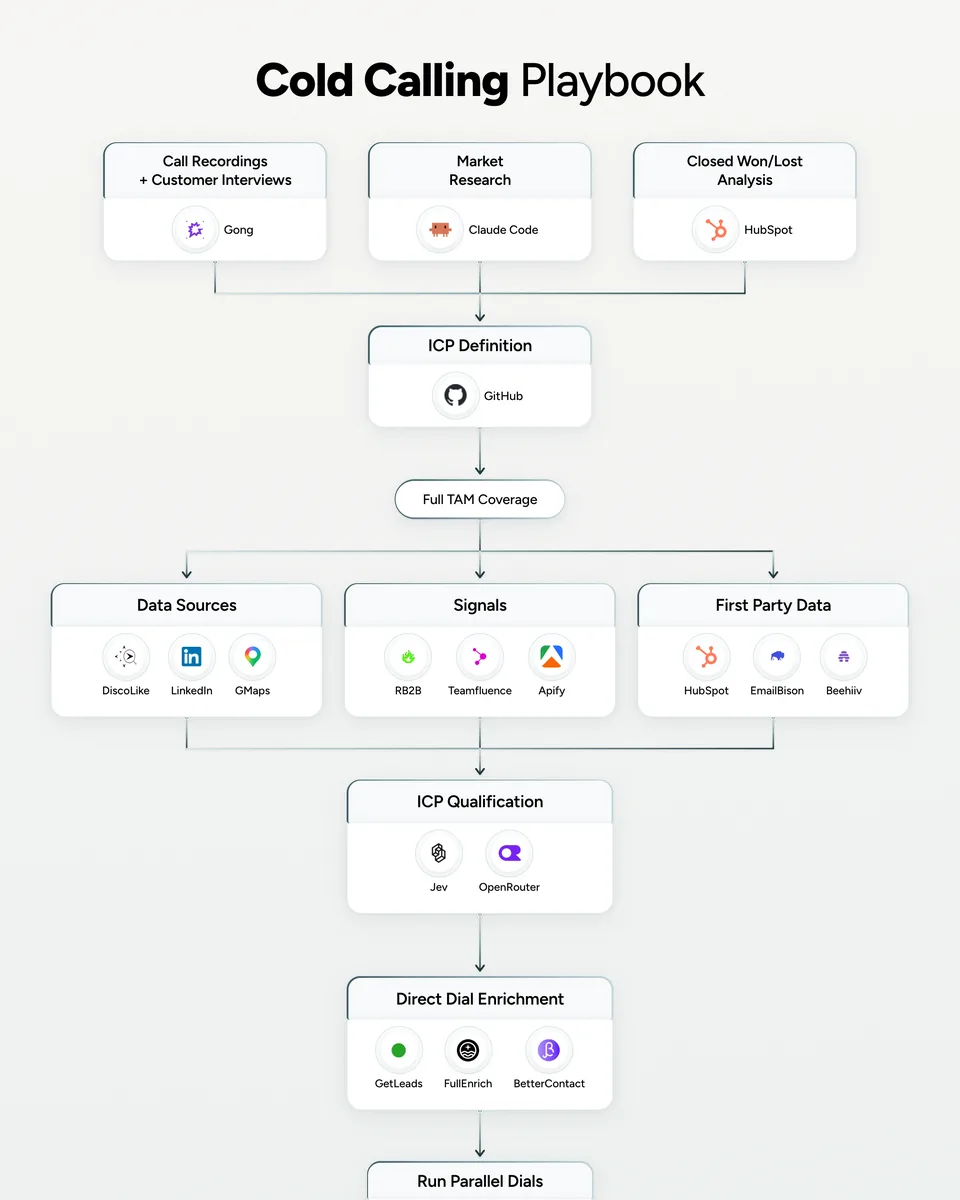
Real conversations and your deal history become one written definition of who to target.
- Gong call recordings and customer interviews give you the buyer's own words for the problem.
- Claude Code runs the market research: segments and personas.
- Closed won and closed lost deals in HubSpot are compared to find what separates buyers from non-buyers.
- Website content, open roles and tech stack are checked on both sides
- The result is one ICP file in GitHub:
- Titles by tier, plus titles you never sell to
- Company size, industries and geography
- Disqualifiers, competitors and current customers
- The ICP is reviewed each quarter against the last 90 days of results.
- Gong
- Claude Code
- HubSpot
- GitHub
Every company that fits, pulled from several sources, because no single database holds a whole market.
- Pull from DiscoLike, LinkedIn and Google Maps, since each one sees a different slice of the market.
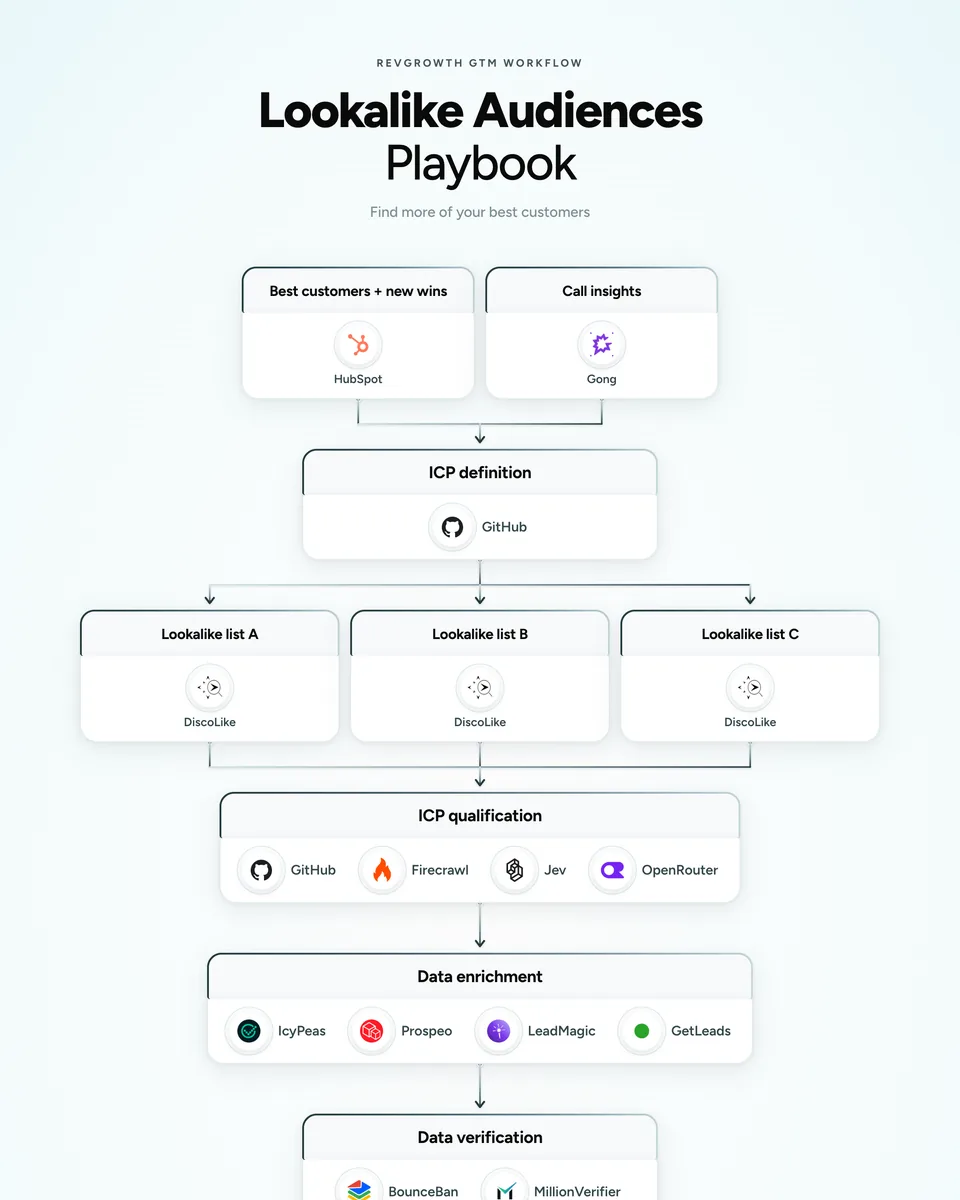
- DiscoLike finds companies by what their websites say, and by similarity to your best customers.
- Google Maps covers local and owner-run businesses that list themselves there.
- Merge the sources and remove duplicates:
- By domain first
- Then by company name and state
- Then by phone number
- Treat any single source's count as a floor for the market size.
- DiscoLike
- LinkedIn
- Google Maps
Who is in market now, grouped by the pain they share, plus the people you have already reached.
- Signals: RB2B names the companies visiting your site, and Apify and Teamfluence pull who engages on LinkedIn.
- Only recent events count as signals. Stale ones are dropped.
- Pain segments: Claude Code groups accounts by the problem they share, so each segment gets its own offer.
- First-party data: reactivate the people you have already reached:
- Past campaigns in EmailBison
- Old CRM leads in HubSpot
- Your Beehiiv newsletter list
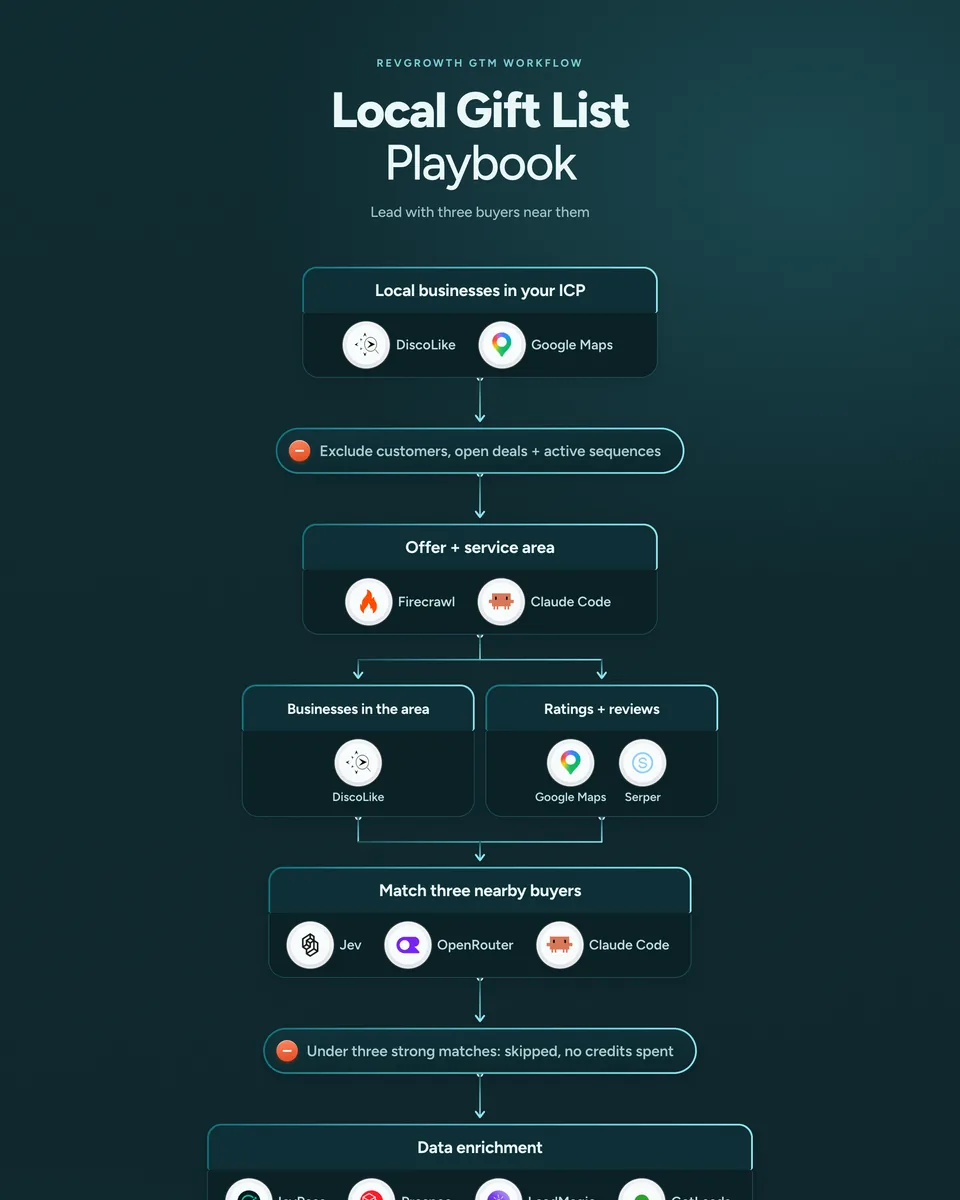
- Current customers and open deals are held out.
- Anyone already in a live campaign is removed, so no one gets two sequences at once.
- RB2B
- Apify
- Teamfluence
- Claude Code
- HubSpot
- EmailBison
- Beehiiv
Each account is checked against the ICP, then the right decision maker and a work email are found.
- Claude Code reads each company's own website, since vendor industry labels are noisy.
- Jev and OpenRouter check each account against the ICP file. Poor fits come out before any paid lookup.
- Pick the decision maker by company size:
- Up to 50 people: owner, founder or CEO
- 51 to 200: VP or director, plus the C-suite
- 201 to 500: director, then VP, then C-suite
- The enrichment waterfall uses IcyPeas, Prospeo, LeadMagic and GetLeads. Each vendor only sees the contacts the ones before it missed.
- Apify and Serper fill gaps that vendor data misses, such as headcount and open roles.
- A contact that qualifies but can't be emailed yet stays on the list with a flag.
- Claude Code
- Jev
- OpenRouter
- IcyPeas
- Prospeo
- LeadMagic
- GetLeads
- Apify
- Serper
Every email is checked twice, by two different verifiers, before anything sends.
- MillionVerifier checks every address first, then BounceBan checks every address that passes.
- Sort each address by the result:
- Valid: goes into the main campaign
- Catch-all: kept only if BounceBan marks it deliverable, and sent from its own campaign so its results read separately
- Invalid, disposable or unknown: removed
- An enrichment vendor's own check never counts as one of the two.
- Role addresses like info@ are never guessed. Only ones a company publishes are used.
- Addresses on self-hosted or regional mail servers get their own campaign, since they bounce more often.
- A campaign paused for two weeks or more is verified again before it resumes.
- MillionVerifier
- BounceBan
An offer for each segment, sent from warmed Google and Microsoft inboxes, with LinkedIn running alongside.
- Claude Code drafts an offer for each pain segment, opening with the words buyers used on your calls.
- Every sequence follows the same rules:
- Two emails in total, with no breakup email
- No link in the first email. It goes out as a reply once they engage.
- Open tracking off
- Mail goes out through EmailBison from Google and Microsoft inboxes, each capped at 20 sends a day.
- Warmup stays on for every inbox, always.
- Each campaign is sized at 1,500 to 2,000 contacts, so its result is readable.
- HeyReach runs LinkedIn alongside email.
- Claude Code
- EmailBison
- Google
- Microsoft
- HeyReach
Every reply is read, labelled by intent and routed, and leads land in your CRM with a Slack alert.
- Replies from email and LinkedIn land in MasterInbox, where each one is labelled by intent.
- Route by label:
- Interested: a reply or call task for the rep in HubSpot
- Referral: the person they named is contacted next
- Not now: a dated follow-up instead of a call today
- Opt-out: suppressed at once
- Leads sync to HubSpot through OutboundSync, with the full thread attached.
- Slack alerts the team on every routed reply and every booked meeting.
- MasterInbox
- OutboundSync
- HubSpot
- Slack
Each week's results decide what gets paused, fixed or tested next.
- Every Monday, each EmailBison campaign is checked:
- Bouncing over 3%: paused
- At 2%: watched for the week
- No interested replies in two weeks: new angles
- Sending volume dropped: senders checked
- Each week, one segment gets 5 to 7 new versions to test.
- Each version changes one thing only: the subject, the first line or the offer.
- New versions are reviewed before they send.
- The winners feed the next offer, and you get a performance update every Friday.
- EmailBison
- Every Monday, each EmailBison campaign is checked:
Want this running for your market?
We build it on your data and your offer, then run it with your team. It starts with a 30-minute strategy call.
Book a strategy call