Permissionless Value Props Playbook
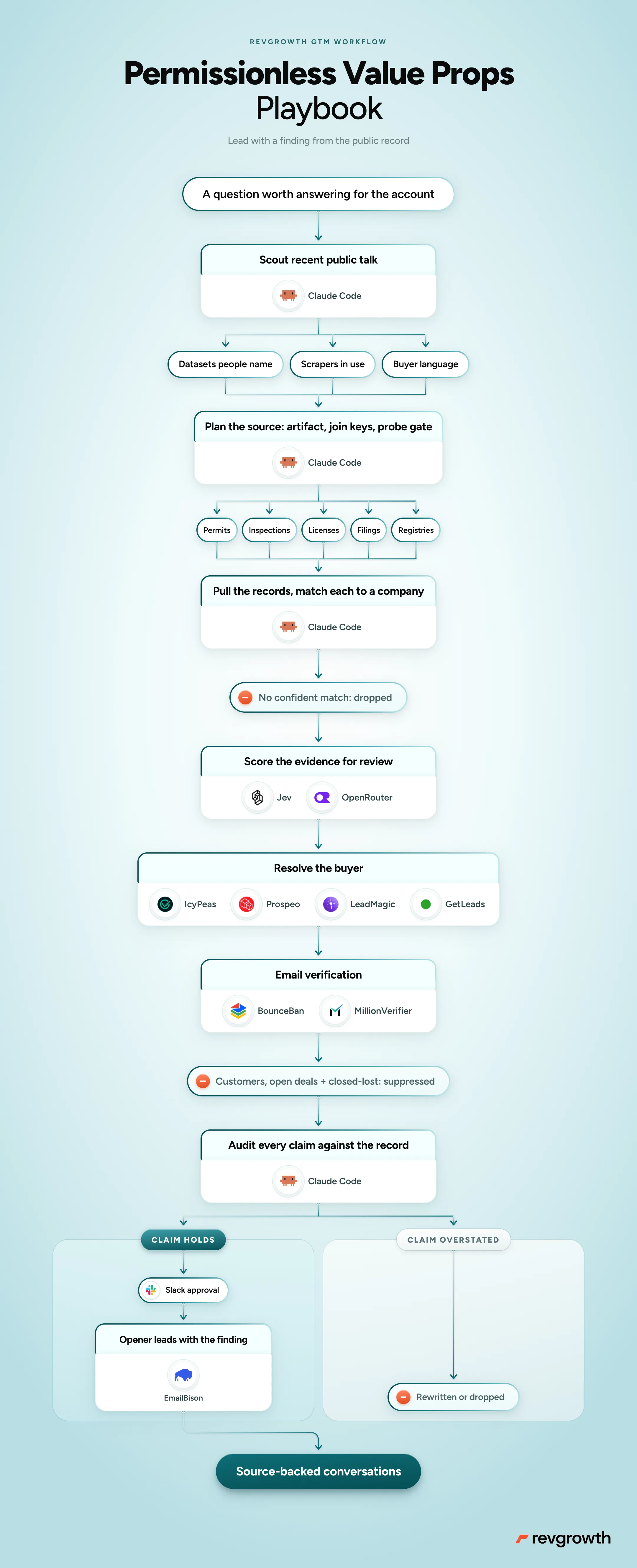
Lead with a finding from the public record. A permit, inspection, license or filing proves something happened, private data resolves the buyer, your CRM decides whether to act, and every claim is checked against the record before the first email.
Tools used
 Claude Code
 Jev
Jev OpenRouter
 IcyPeas
 Prospeo
 LeadMagic
 GetLeads
 MillionVerifier
 BounceBan
 HubSpot
 Slack
Slack EmailBison
How it works
Pick the finding that would help the account even if they never buy from you.
- The framing comes from Jordan Crawford at Cannonball GTM: combine two to five data sources into an insight the prospect doesn't already have.
- Write the source map before any copy:
- The market question
- The public source of truth
- How a record joins to a company
- Who resolves the buyer
- The first-party filter
- The evidence fields a reader needs to trust it
- What gets dropped before anything sends
Claude Code fans out across public conversations to find where the data lives and what buyers call it.
- Claude Code runs a research scout across Reddit, X, YouTube transcripts, GitHub, Hacker News and the web, ranked by engagement and recency.
- It returns the datasets people name, the scrapers already in use, and the words real buyers use.
- Write the prompt like a data operator: ask for records, source systems, fields and evidence.
- The scout finds the source trail. The pipeline comes after it.
- Claude Code
Claude Code turns the trail into a build sheet before a single row is pulled.
- Claude Code names the exact artifact, its canonical URL, the join keys and the route for each source.
- A probe gate comes first: can we pull 25 rows with stable IDs and a current status?
- Every source gets a cost check before the full run.
- Claude Code
Permits, inspections, licenses, filings and registries become rows, and every row is matched to a company.
- Claude Code pulls the rows and keeps the record ID, the date and the source URL on every one.
- Each record is matched to a company, facility or owner, with the match confidence written down.
- A record with no confident match is dropped, so the workflow never scores the wrong company.
- Sources that work this way:
- OSHA inspections, for safety and compliance vendors
- FMCSA carrier records, for fleet, insurance and compliance
- City business licenses, for restaurant owners
- MSHA accident and inspection data, for mining safety
- Claude Code
Accounts are ranked on what the record shows, for a person to review.
- Jev and OpenRouter score each account on the evidence in its record.
- The score orders the review queue. It never becomes a claim in the email.
- Jev
- OpenRouter
Only once the account has a reason does anyone look for a person.
- The enrichment waterfall uses IcyPeas, Prospeo, LeadMagic and GetLeads to find the person who owns the problem the record shows.
- Each vendor only sees the contacts the ones before it missed.
- IcyPeas
- Prospeo
- LeadMagic
- GetLeads
Every email is checked twice before anything sends.
- MillionVerifier checks every address first, then BounceBan checks every address that passes.
- An enrichment vendor's own check never counts as one of the two.
- MillionVerifier
- BounceBan
Customers, open deals and closed-lost accounts come off the list.
- Every account is checked in HubSpot before it moves on.
- The reason for each suppression stays on the row.
- HubSpot
Claude Code checks each line against the fields in the row before anyone reads it.
- Claude Code lists what the record supports, what it doesn't, and any word that overstates certainty.
- Nothing implies risk, urgency, savings, legal exposure or intent unless the row supports it.
- An overstated claim is rewritten or dropped.
- Claude Code
A person approves each send, and the opener leads with what you found.
- A Slack approval puts a person on every send.
- Emails in EmailBison lead with the finding, cite only fields in the row, and stay under 45 words.
- One version asks for a correction instead of a meeting.
- The source URL and record ID go into the CRM note.
- Slack
- EmailBison
Want this running for your market?
We build it on your data and your offer, then run it with your team. It starts with a 30-minute strategy call.
Book a strategy call